

By the time Elvis Presley’s hips ignited living rooms across America, Tom Parker was already scripting his future—and his limits. Parker wasn’t really a “Colonel.” Nor was he born in the U.S. He was a former carnival barker from the Netherlands named Andreas Cornelis van Kuijk, a man who’d lived on the lam, stitched his identity together from scraps of Americana, and sold it back to the world at a profit.
As Ben Sisario writes in the New York Times, in his new book, The Colonel and the King, music historian Peter Guralnick paints a more complicated portrait than history has previously allowed. For decades, Parker has been dismissed as a villain: the man who choked Elvis’ artistry, locked him in a Vegas showroom, and bled his fortune dry. But Guralnick’s new book, grounded in personal correspondence and unpublished documents, reveals something much more tragic—and more human.
Parker was a master of logistics and illusion. He knew how to sell a myth. But as Guralnick shows, he also operated from deep insecurity. He feared exposure, not just as an undocumented immigrant, but as someone fundamentally unworthy of the empire he built. He clung to Elvis like a lifeboat, always keeping one hand on the hull and the other in the ledger book.
Elvis, meanwhile, needed a father more than a manager. His own dad, Vernon, once said Elvis was born special—perhaps because his twin brother, Jesse, was stillborn. “Would his life have been different if Jesse had lived?” Vernon once asked. Maybe. Or maybe that emptiness would always have followed him, driving him to fill arenas, hotel rooms, and his bloodstream with everything but peace.
In Parker, Elvis found a surrogate father. And like many father-son bonds, it was marked by devotion, disappointment, and silent resentment. Parker orchestrated the RCA deal, the Hollywood films, the Las Vegas residency. He created Elvis, Inc. But he also denied Elvis the world. While the Beatles toured Europe, Elvis stayed put. Parker, afraid his illegal status would be discovered if they left the country, always found a reason to say no.
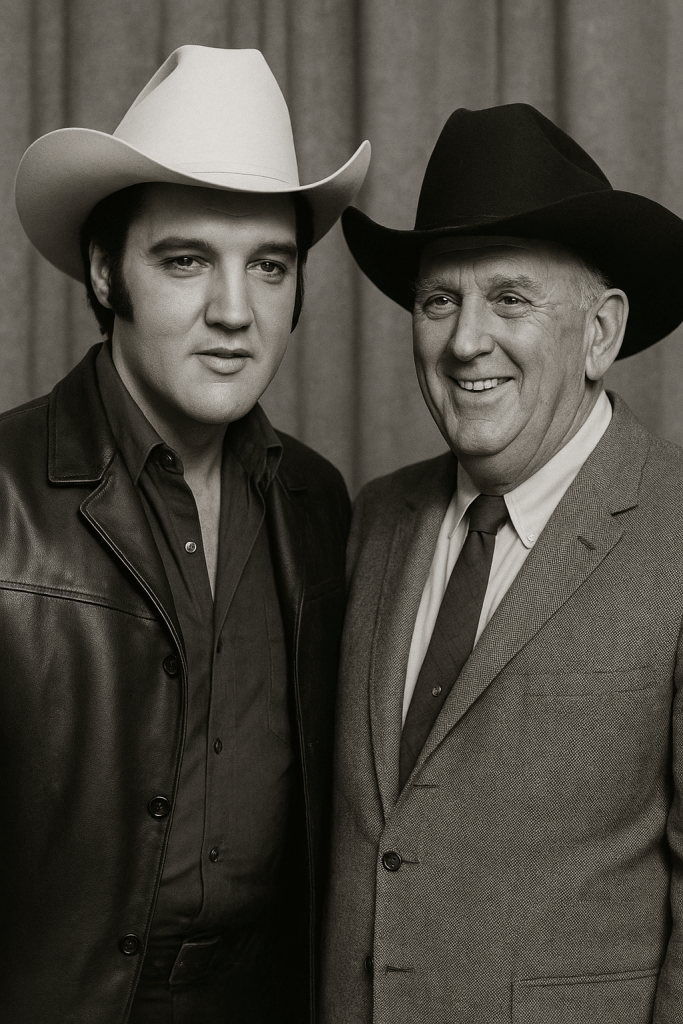
The mythology has often framed Elvis as the naïve pawn. Guralnick disagrees. Elvis knew the rules of the game. He accepted them—until the rules became a cage. At times, he wanted more: dramatic roles, international acclaim, personal freedom. But when push came to shove, he rarely acted on those desires. Perhaps it was loyalty. Perhaps it was fear.
Or perhaps he, too, was addicted—to the comfort of being managed, to the illusion of being cared for.
Their bond wasn’t just professional. It was familial. And like many families, it was both sacred and dysfunctional. Elvis never fired Parker, even when Priscilla and others begged him to. And Parker, even after Elvis died, still referred to him as “my boy.”
“My boy is gone,” he said in 1977, not long after Elvis’ death. It wasn’t an act. It was grief. Genuine, if oddly possessive.
There’s a moment Guralnick recounts from the early 1960s, after the Beatles had exploded onto the American scene. Elvis was losing cultural ground. Instead of pivoting creatively, Parker doubled down on what he knew—merchandise, TV specials, and safe movie roles. Elvis didn’t fight it. Maybe he couldn’t. Maybe he believed, as Parker did, that survival meant safety, even if it cost him his soul.
By the 1970s, Elvis was performing nightly in Las Vegas while Parker gambled away fortunes just floors above. It was spectacle turned routine, glory turned exhaustion. Their lives were no longer about ascension, but maintenance. Elvis grew bloated on isolation and medication. Parker tried to keep the lights on. In the end, neither could save the other.
The Colonel and the King doesn’t redeem Parker, but it invites compassion. He wasn’t evil. He was scared. He wasn’t just greedy. He was scarred. And Elvis? He wasn’t just exploited. He was complicit, confused, and—in the end—profoundly lonely.
Their story isn’t just a showbiz cautionary tale. It’s a story about what happens when two people mistake control for love, performance for connection, and loyalty for freedom. It’s about how hard it is to rewrite the script of your life when you’ve handed someone else the pen.
In Parker’s final years, broke and fading in Las Vegas, he reportedly kept Elvis memorabilia scattered around his modest home. To the end, he remained the Colonel. But the King was gone.
Discover more from Fatherhood Channel
Subscribe to get the latest posts sent to your email.