

Most dads don’t need more advice.
They need better questions.
Questions that slow things down.
Questions that help them respond instead of react.
Questions that translate good intentions into daily behavior.
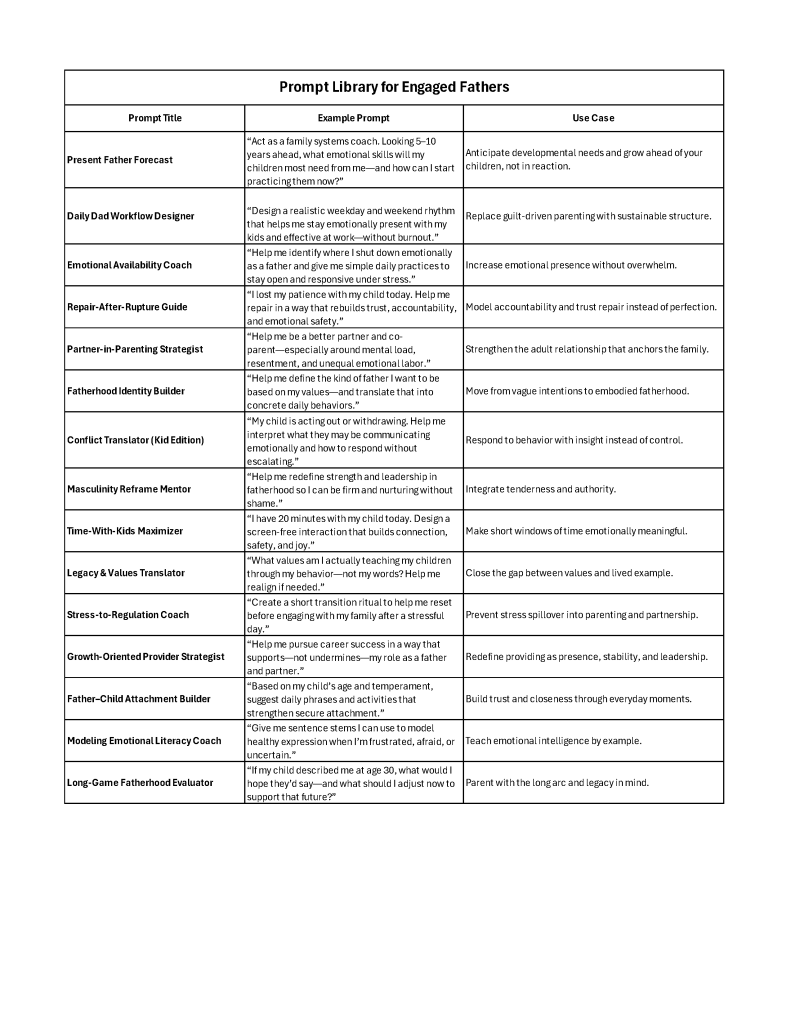
The prompts below are designed for fathers who want to be more engaged parents, more reliable partners, and stronger, steadier men—without losing themselves in the process.
You don’t need to do all of them.
Pick one. Use it once. Notice what shifts.
1. Present Father Forecast
Prompt:
“Act as a family systems coach. Looking 5–10 years ahead, what emotional skills will my children most need from me—and how can I start practicing them now?”
Why it matters:
Great fathers don’t just respond to today’s challenges—they prepare for who their kids are becoming.
2. Daily Dad Workflow Designer
Prompt:
“Design a realistic weekday and weekend rhythm that helps me stay emotionally present with my kids and effective at work—without burning out.”
Why it matters:
Presence isn’t about doing more. It’s about designing life so connection actually fits.
3. Emotional Availability Coach
Prompt:
“Help me identify where I shut down emotionally as a father. Give me simple daily practices to stay open and responsive—especially under stress.”
Why it matters:
Kids don’t need perfect dads. They need reachable ones.
4. Repair-After-Rupture Guide
Prompt:
“I lost my patience with my child today. Help me repair in a way that rebuilds trust, accountability, and emotional safety.”
Why it matters:
Repair teaches resilience, responsibility, and trust—far more than never messing up.
5. Partner-in-Parenting Strategist
Prompt:
“Help me be a better co-parent and partner—especially around mental load, resentment, and emotional labor.”
Why it matters:
Strong fatherhood is built on strong partnership, even when it’s complicated.
6. Fatherhood Identity Builder
Prompt:
“Help me define the kind of father I want to be based on my values—and translate that into concrete daily behaviors.”
Why it matters:
When you name the father you want to be, your choices get clearer.
7. Conflict Translator (Kid Edition)
Prompt:
“My child is acting out or withdrawing. Help me understand what they may be communicating emotionally—and how to respond without escalating.”
Why it matters:
Behavior is communication. Interpretation changes everything.
8. Masculinity Reframe Mentor
Prompt:
“Help me redefine strength and leadership in fatherhood so I can be firm and nurturing without shame.”
Why it matters:
Real strength includes tenderness, accountability, and emotional courage.
9. Time-With-Kids Maximizer
Prompt:
“I have 15–30 minutes with my child today. Design a screen-free interaction that builds connection, safety, and joy.”
Why it matters:
Connection isn’t about quantity of time—it’s about quality of attention.
10. Legacy & Values Translator
Prompt:
“What values am I actually teaching my children through my behavior—not my words?”
Why it matters:
Kids learn more from who we are than what we say.
11. Stress-to-Regulation Coach
Prompt:
“Create a short transition ritual to help me reset before engaging with my family after a stressful day.”
Why it matters:
How you come home sets the emotional tone of the household.
12. Growth-Oriented Provider Strategist
Prompt:
“Help me pursue career success in a way that supports—not undermines—my role as a father and partner.”
Why it matters:
Providing isn’t just financial. It’s emotional and relational, too.
13. Father–Child Attachment Builder
Prompt:
“Based on my child’s age and temperament, suggest daily phrases and activities that strengthen secure attachment.”
Why it matters:
Attachment is built in small, ordinary moments—repeated consistently.
14. Modeling Emotional Literacy Coach
Prompt:
“Give me sentence stems I can use to model healthy emotional expression when I’m frustrated, afraid, or uncertain.”
Why it matters:
Your kids learn how to handle feelings by watching how you handle yours.
15. Long-Game Fatherhood Evaluator
Prompt:
“If my child described me at age 30, what would I hope they’d say—and what should I adjust now to support that future?”
Why it matters:
Fatherhood is a long game. Small shifts now compound over time.
A Final Thought
Being a good father isn’t about having all the answers.
It’s about staying curious, accountable, and connected—even when it’s hard.
If one of these prompts helped you pause, soften, or show up differently today, it did its job.
Start there.
Discover more from Fatherhood Channel
Subscribe to get the latest posts sent to your email.