
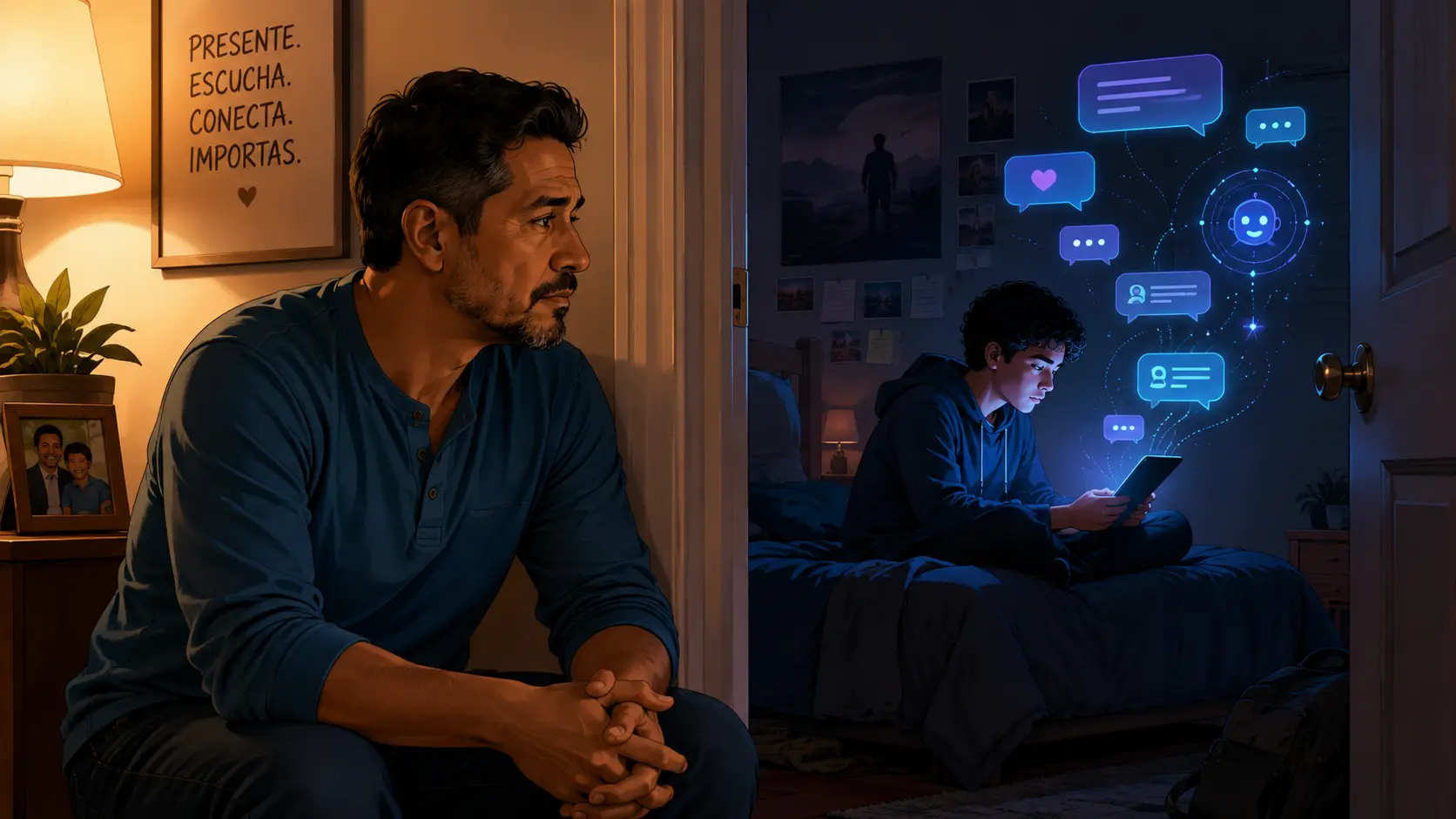
Your child may not be sneaking out. They may not be vaping. They may not be failing school.
They may simply be upstairs, emotionally attached to an AI chatbot that always listens, never rolls its eyes, never says, “I’m busy,” and never asks them to clean their room.
For many parents, that may sound harmless. For fathers especially, it may even sound like a relief. Finally, something in the house besides the dog is available 24/7 and doesn’t need a ride somewhere.
But before we relax too much, there is a question we need to ask:
What need is AI meeting in our children that we are not?
That question is not meant to shame parents. Most parents are exhausted. Many fathers are carrying invisible pressure: bills, work, aging parents, relationship stress, their own loneliness, and the quiet fear that they are somehow failing the people they love most. The U.S. Surgeon General has warned that parental stress is now a serious public health concern, with parents and caregivers needing more support for their own well-being and for their children’s long-term health.
So this is not another article saying, “Parents, do more.” Parents have been “doing more” since before breakfast.
This is an invitation to do something different.
The new listener in the house
Artificial intelligence is quickly becoming part tutor, part search engine, part coach, part diary, part therapist, and part friend.
For teenagers, that can be especially powerful. A chatbot does not get tired. It does not look disappointed. It does not glance at its phone while a child is talking. It does not say, “We’ll talk later,” and then forget.
That can feel magical to a lonely child.
It can also become risky.
Pew Research Center has reported that teens are increasingly using AI tools, including chatbots, as part of daily life and schoolwork. Common Sense Media found that nearly three in four teens have used AI companions, described as digital friends or characters teens can interact with at will.
That does not mean every teen who talks to AI is in danger. Many are curious. Many are playing. Many are using these tools creatively, responsibly, and even helpfully.
But we should not miss the emotional side of what is happening.
A child who repeatedly turns to a machine for comfort, reassurance, advice, identity, romance, or emotional rescue is telling us something. Not always with words. Sometimes with a closed bedroom door, a glowing screen, and a nervous laugh when we ask, “Who are you talking to?”
Why AI feels safe to kids
Children and teenagers often open up where they feel safest.
That may not be where they are loved most. It may be where they feel least judged.
AI has some built-in advantages. It is patient. It is responsive. It can be flattering. It remembers what a child shares. It can mirror a child’s feelings back in language that sounds caring.
For a teen who feels awkward, anxious, misunderstood, rejected, or invisible, that can be intoxicating.
And to be fair, many parents are not easy to talk to. We interrupt. We correct. We lecture. We panic. We turn a child’s confession into a courtroom hearing.
A daughter says, “I feel like nobody likes me.”
Dad says, “That’s not true. You have plenty of friends.”
A son says, “I think I’m depressed.”
Dad says, “You just need to get outside more.”
A teen says, “I messed up.”
Dad says, “What did you do now?”
And just like that, the child learns: do not bring your tender places here.
Most fathers do not mean to shut their children down. We are trying to help. We are trying to protect. We are trying to fix pain because watching our children hurt is almost unbearable.
But children are not broken appliances. They do not always need a repairman. Sometimes they need a witness.
The danger is not the technology. It is the replacement.
The goal is not to panic every time a teenager uses AI.
The danger is not that AI talks to our kids. The danger is that AI may become easier to talk to than we are.
That should get our attention.
Researchers are already studying how young people rely on AI companions. Some early research suggests that teens may begin with entertainment or creative play, but overuse can become tied to sleep loss, academic struggles, withdrawal, and strained real-world relationships. Other research suggests people with fewer strong human supports may be more likely to turn to AI companions, and that intense emotional self-disclosure to chatbots may not fully substitute for human connection.
Again, that does not mean AI is evil.
It means AI is powerful.
And powerful tools need wise adults.
The fatherhood wake-up call
For fathers, this moment is not just about screen time. It is about emotional availability.
Many dads were raised to provide, protect, and push through. Those are not small things. They matter. Children need food, safety, structure, and someone who knows how to open jars that apparently were sealed by NASA.
But children also need fathers who can listen without immediately correcting, advising, minimizing, or escaping into silence.
A child should not have to go to a chatbot to hear:
“That sounds hard.”
“I’m glad you told me.”
“Tell me more.”
“I’m not angry. I want to understand.”
“I love you, and we will figure this out together.”
Those are not therapy lines. They are relationship lines. They are bridge-building lines. They are the words that tell a child, “You can bring your real self here.”
What fathers can do tonight
Start small. Small is how trust is rebuilt.
Tonight, try ten minutes of no-fixing listening.
Not an interrogation. Not a lecture. Not a TED Talk from the Kitchen Counter Institute of Parental Wisdom.
Ten minutes.
Ask one question:
“What has been on your mind lately that I might not know about?”
Then listen.
When your child answers, resist the ancient parental reflex to correct the first inaccurate sentence. If they say, “Everyone hates me,” do not begin with, “That’s ridiculous.” Try, “It feels that way today?” or “That sounds really lonely.”
You are not agreeing with every word. You are making room for the feeling beneath the words.
That is where connection begins.
Ask better questions
Many children hear from parents only when something needs to be managed.
Homework done?
Room clean?
Did you text your mother?
What time is practice?
Why is there a spoon in the couch?
These are necessary questions. Especially the spoon. But they are not enough.
Try asking questions that are not about performance:
“What made you laugh today?”
“What felt heavy today?”
“What do you wish adults understood better?”
“Who do you feel most yourself around?”
“When do you feel pressure to pretend?”
“What do you like about talking to AI?”
That last one matters. Do not ask it like a prosecutor. Ask it like a curious father.
You may learn that your child uses AI for homework help. Or boredom. Or jokes. Or loneliness. Or advice. Or because the chatbot feels less scary than talking to you.
That answer may sting.
Let it sting without making your child responsible for comforting you.
Do not compete with AI on availability. Compete on humanity.
No parent can be available 24 hours a day. AI can.
No parent can respond instantly every time. AI can.
No parent can be endlessly patient. AI can imitate that.
So do not try to beat the machine at being a machine.
Win where humans still matter most.
A father can hug. AI cannot.
A father can show up at the game. AI cannot.
A father can apologize and repair. AI cannot truly know it caused pain.
A father can tell family stories. AI cannot remember the day your child was born, the way your knees nearly gave out, the first time tiny fingers wrapped around yours, or how you promised silently, “I will do my best.”
A father can give moral guidance rooted in love, history, sacrifice, and real relationship.
AI can respond.
A father can care.
There is a difference.
Teach children what AI is — and what it is not
Children need clear, simple guidance.
AI can be useful.
AI can help explain homework, brainstorm ideas, practice conversations, and answer questions.
But AI is not a best friend. It is not a parent. It is not a therapist. It is not a conscience. It does not love you. It does not know you. It does not have wisdom, even when it sounds wise.
It is a tool that produces responses.
Some responses may be helpful. Some may be wrong. Some may be unhealthy. Some may be flattering in ways that keep a child coming back.
Children need to know that emotionally powerful technology can still be emotionally empty.
That is a hard truth even for adults. Maybe especially for adults.
Create family rules without creating secrecy
Parents should set boundaries around AI, especially for younger children and vulnerable teens. But rules work best when they are paired with relationship.
A rule without connection becomes a dare.
Consider family guidelines such as:
No AI companions late at night.
No sharing private identifying information.
No asking AI for help with self-harm, abuse, medical decisions, or dangerous situations without involving a trusted adult.
No romantic or sexual AI relationships for minors.
Parents can review apps and settings.
Bring confusing or upsetting AI conversations to a parent without fear of punishment.
That last one is essential.
If a child thinks, “If I tell Dad, he’ll take everything away,” the child will hide. If the child thinks, “Dad may set limits, but he will not humiliate me,” the child is more likely to come forward.
The conversation we should be having
This is not really a technology story.
It is a connection story.
AI is exposing a hunger that was already there: the hunger to be heard, known, accepted, guided, and not laughed at for having feelings.
Our children are growing up in a world of constant contact and fragile connection. They can message anyone and still feel alone. They can have hundreds of followers and no one to sit with at lunch. They can ask a chatbot a question at midnight that they are afraid to ask their father at dinner.
That should break our hearts a little.
Not because we are doomed.
Because we are needed.
A promise worth making
Try saying this to your child:
“I know technology is part of your life. I’m not here to freak out or judge you. But I want you to know something. No app, chatbot, or screen has to carry the hard stuff alone with you. You can bring those things to me. I may not always say it perfectly, but I want to listen. I want to understand. I want to be someone you can come to.”
Then prove it.
Not once. Over and over.
That is how trust is built. Not by one dramatic conversation, but by many small moments where a child risks honesty and a parent responds with steadiness.
AI is listening to our kids. Are we?
The goal is not to ban every chatbot or win a war against technology. The goal is to make sure our children know the difference between a machine that responds and a father who truly cares.
Our children do not need perfect parents.
They need available ones.
They need fathers who can sit on the edge of the bed and not rush the conversation. Fathers who can take a walk without turning it into a lecture. Fathers who can say, “I’m sorry, I missed that,” and mean it. Fathers who can listen long enough for the real story to come out.
AI may be listening.
But we can listen with love.
And love, unlike artificial intelligence, is not artificial.
Discover more from Fatherhood Channel
Subscribe to get the latest posts sent to your email.